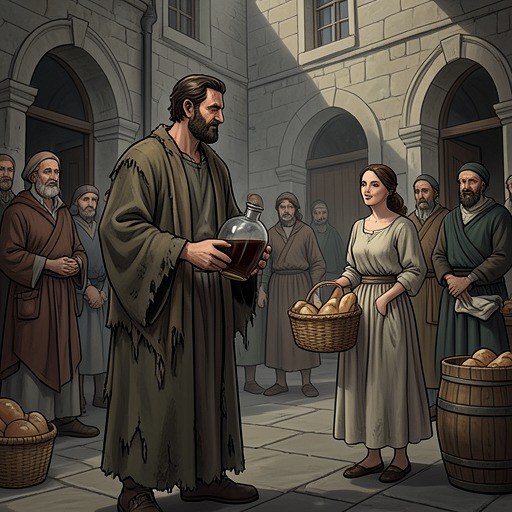
Madam Giovanna
The DecameronMadam Giovanna is the central figure in a tale of love tested by poverty, maternal devotion, and an act of hospitality that costs its giver his last treasured possession. First courted without responding to his costly displays, she later comes to value Federigo degli Alberighi for a generosity that survives the loss of his fortune. Her final decision to marry him turns that recognition into a life-changing choice of her own.
Identity and Introduction
The story is presented by the queen as one about the power of love in noble hearts and the possibility of giving reward through one’s own judgment rather than leaving everything to fortune. Its account comes through Coppo di Borghese Domenichi, who used to tell of Federigo degli Alberighi, a young man in Florence renowned for arms and courtesy, and of Madam Giovanna, then regarded as one of the city’s fairest and most spirited women.
Federigo degli Alberighi fell in love with Madam Giovanna and sought to win her through jousts, tournaments, entertainments, and gifts. He spent his substance freely, but she, described as virtuous as well as beautiful, paid no heed either to those efforts or to him. His pursuit therefore brought no immediate return: his wealth was exhausted, and he was left with a small farm and a falcon. The contrast between his former lavish courtship and his later poverty shapes the circumstances of their eventual meeting.
Widowhood and Her Son’s Request
After Madam Giovanna’s husband died, she went for the summer with their son to an estate near Federigo degli Alberighi’s farm at Campi. Her son became acquainted with Federigo degli Alberighi and took a particular delight in hawks and hounds. Having often seen Federigo’s falcon flown, he grew so eager to possess it that he would not ask for it, knowing how dear the bird was to its owner.
The boy then fell ill. Madam Giovanna, who had no other child and loved him deeply, stayed beside him and repeatedly offered to procure anything he wanted. At last he told her that he thought he would soon recover if only he could have Federigo’s falcon. His request placed her between a mother’s wish to comfort her son and her knowledge that the bird was not an incidental possession: it was Federigo degli Alberighi’s remaining pleasure and, in his poverty, part of what sustained him.
Madam Giovanna considered this difficulty before deciding to go herself, rather than send someone else, to ask for the falcon. She promised her son she would fetch it the following morning, and he rejoiced at her promise and showed some improvement that same day. The choice is both purposeful and costly in its implications: she is willing to approach a man whose love she had once disregarded, because her son’s need now outweighs her reluctance.
The Visit and the Falcon
The next morning Madam Giovanna went to Federigo degli Alberighi’s little house with another woman for company. She found him in his garden and greeted him graciously, then invited herself to dine with him, presenting the visit as a chance to make amends for the suffering his past love had caused him. Federigo welcomed her, saying that her presence mattered more than the riches he had once spent. His courtesy remained intact, but the visit exposed the distance between his former means and his present circumstances.
Unable to find money or anything to pawn, and unwilling to ask his laborer or anyone else for help, Federigo degli Alberighi looked to the falcon. He killed and prepared the bird so he could set before Madam Giovanna a dish worthy of his guest. She ate it without knowing what she had been served. Only after dinner, during their conversation, did she explain the real purpose of her visit: her son was enamoured of the falcon, and she feared his illness might worsen if she returned without it.
Federigo then revealed that he could not grant her request because he had already served the falcon at the meal. He explained that, on hearing of her visit, he had judged the bird a fitting way to honour her. To show her what had happened, he produced its feathers, feet, and beak. The object of her son’s longing had become the proof of Federigo’s hospitality—and of how completely his attempt to honour Madam Giovanna had defeated her purpose.
Loss, Choice, and Marriage
Madam Giovanna first reproached Federigo degli Alberighi for killing so fine a falcon to serve a woman. Yet she also inwardly admired the greatness of spirit that his poverty had not diminished. Without the bird, she had no hope of fulfilling her son’s wish. She returned to him distressed, and within a few days he died, whether from disappointment at not receiving the falcon or from the course of his illness. His death is the immediate consequence of the errand, but the story does not present Madam Giovanna as able to control its outcome: she had tried to satisfy him, and Federigo had acted without knowing what she would ask.
Madam Giovanna remained in grief for a time. Because she was still young and had been left very rich, her brothers urged her more than once to marry again. She would have preferred to remain a widow, but, pressed by them, she recalled Federigo degli Alberighi’s merit and his final act of magnificence. She told her brothers she would take no other husband than Federigo. When they objected that he possessed nothing, she answered that she would rather have a man who lacked riches than riches that lacked a man.
Her brothers knew Federigo degli Alberighi to be a man of great merit and gave her, with all her wealth, to him. Federigo, now married to the woman he had long loved and restored to prosperity through her fortune, became more careful with his substance. The tale ends with the two living together in joy and comfort. Madam Giovanna’s choice does not erase the loss of her son; rather, it establishes a new future in the wake of that grief, founded on an esteem she reached through experience rather than through Federigo’s earlier expenditure.
Narrative Significance
Madam Giovanna’s arc reverses the terms of Federigo degli Alberighi’s first courtship. At first, his wealth and costly gestures do not win her attention; later, when he has almost nothing, his instinct to offer the best he can becomes the act she remembers when choosing a husband. The falcon binds these stages together: prized by her son, indispensable to Federigo, and unknowingly eaten by the person who came to request it, it makes generosity concrete while exposing the limits of intention.
The ending also gives Madam Giovanna a decisive role in how fortune’s reversal is resolved. Her brothers may press her to remarry, but she names the husband she wants and persuades them through her judgment of his worth. The final match joins Federigo degli Alberighi’s courtesy and merit to Madam Giovanna’s wealth, while the story’s emphasis falls not on wealth alone but on the character that remained when his wealth was gone.